Khmer Manuscript Heritage Project
Cambodia's manuscript heritage is a priceless storehouse of Khmer cultural knowledge, Buddhist scholarship, and artistic achievement.
Cambodia's manuscript heritage is a priceless storehouse of Khmer cultural knowledge, Buddhist scholarship, and artistic achievement.
In 2019, the Buddhist Digital Resource Center embarked on an ambitious project to digitize thousands of endangered manuscripts in Cambodia. More than 1.4 million pages of these precious texts are now digitally archived and available to the world for the first time.
Cambodia's manuscript heritage is a priceless storehouse of Khmer cultural knowledge, Buddhist scholarship, and artistic achievement. For hundreds of years Cambodia's traditional manuscripts conserved and transmitted Khmer literature, history, science, religion, medicine, and more. Sadly, the vast majority of these texts —95% to 98% of the country's traditional manuscripts— were destroyed during the tumultuous 1970s and 1980s. As a result, much of the knowledge contained in those manuscripts was also lost, dealing a blow to Cambodia's rich cultural heritage.
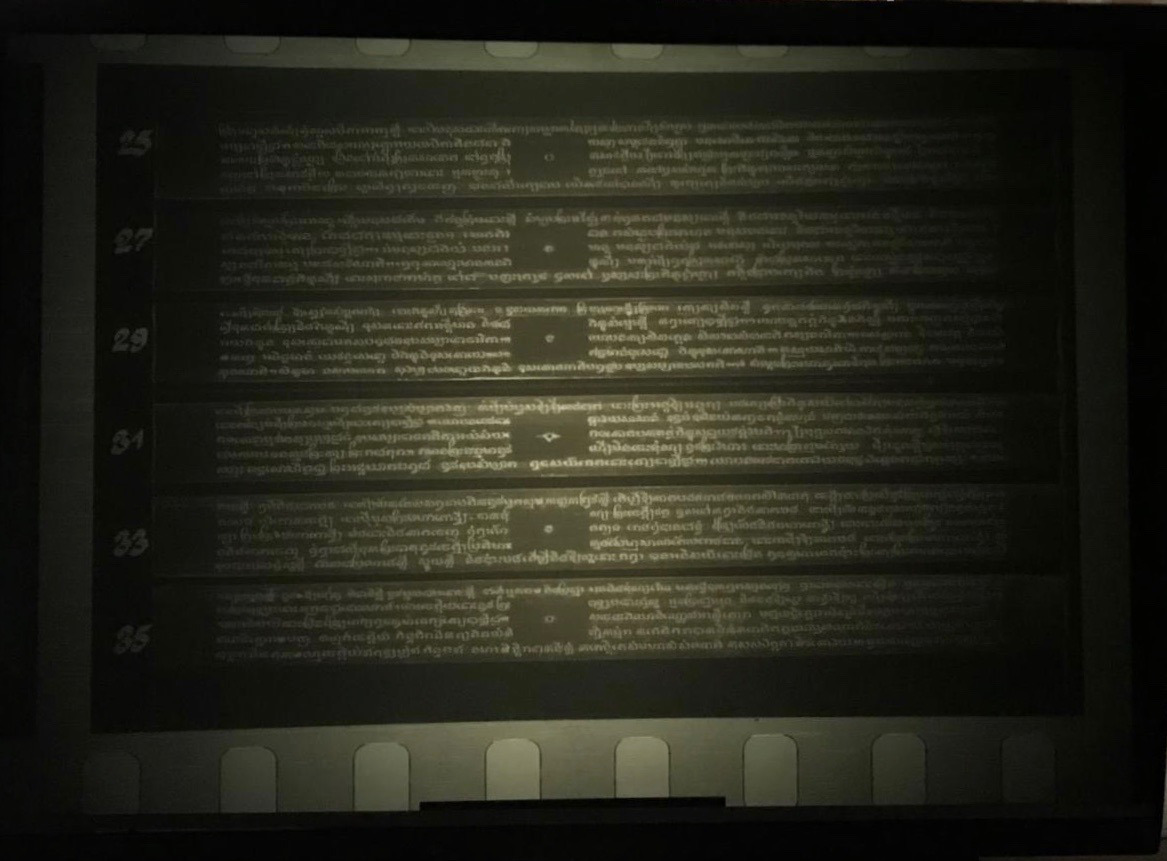
Filmed copies of manuscripts as viewed on the old microfilm machines at the FEMC office.

Digitized and processed images of the filmed manuscripts as viewed in BDRC’s BUDA image viewer. Due to the requirements of archival photography, multiple folios were captured in each frame of film with alternate frames containing all even or all odd pages. The digitization team laboriously cropped each digitized frame to divide the folios into their own images and then collated the pages, which greatly facilitates reading.
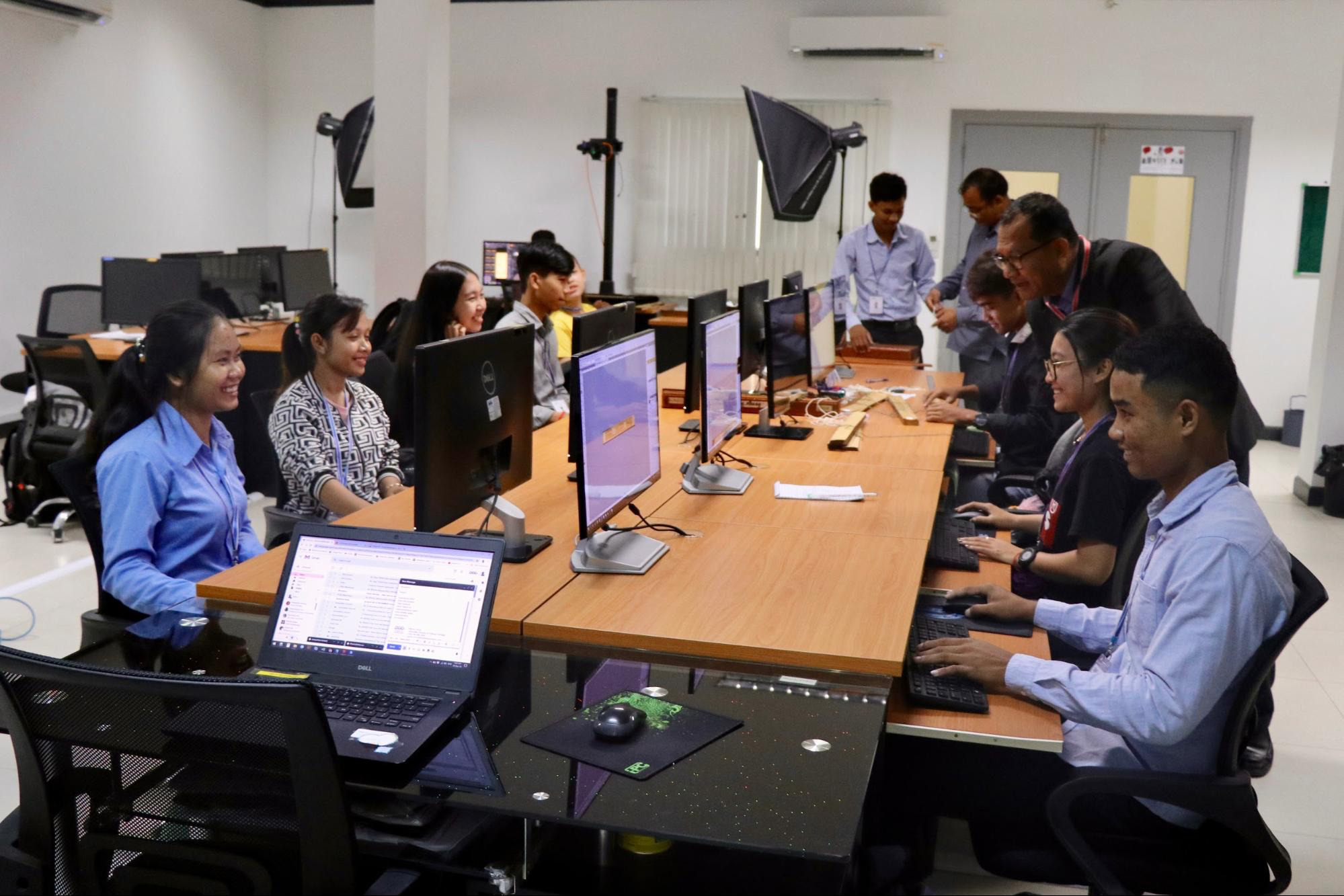
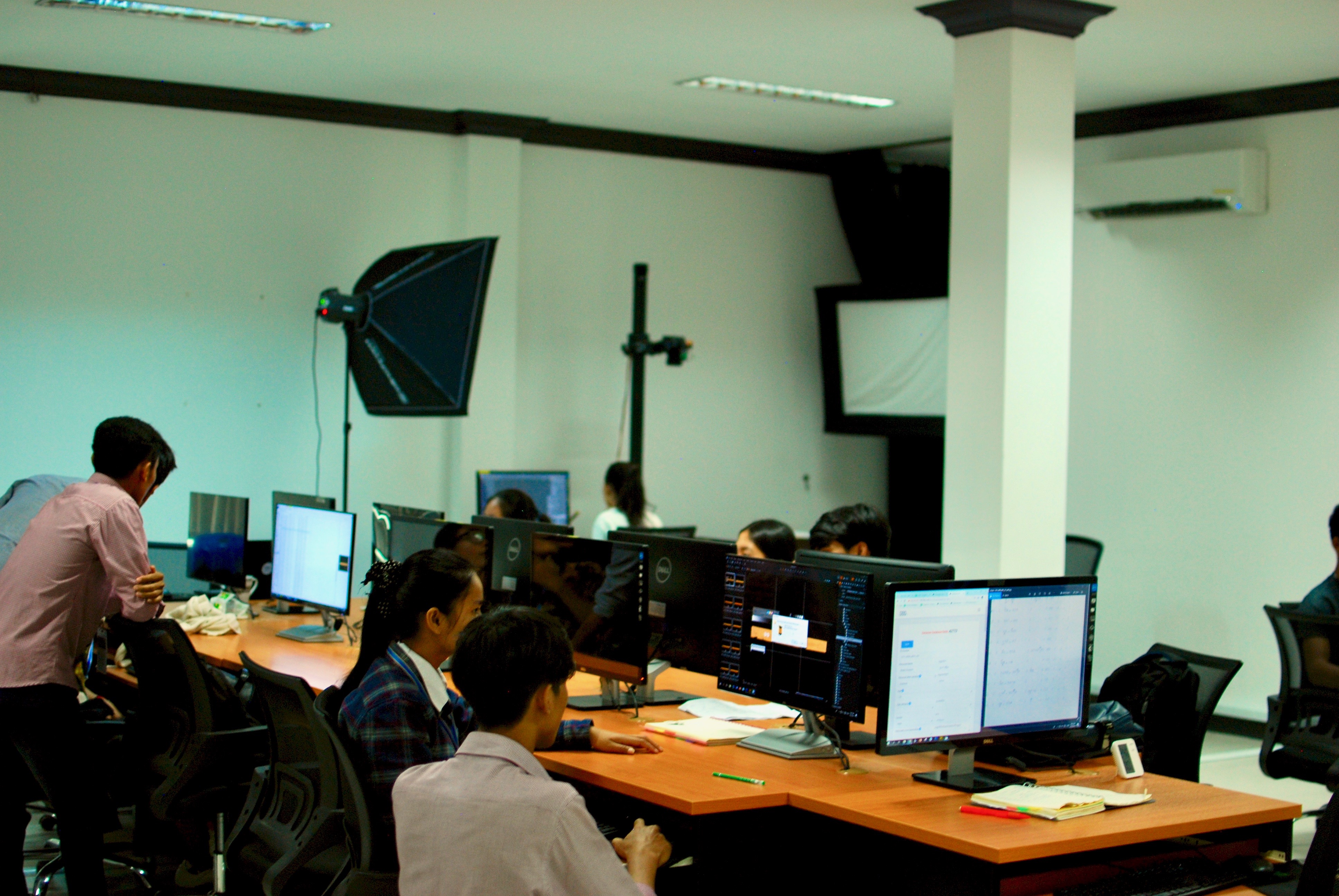
The digitization team at DDD during a visit by H.E. Siyonn Sophearith, Director-General of Techniques for Cultural Affairs, Ministry of Culture and Fine Arts (upper right).
Through the efforts of the Fonds pour l’Édition des Manuscrits du Cambodge (Fund for the Preservation of Cambodian Manuscripts, or FEMC), a project of the École française d’Extrême-Orient (French School of Asian Studies, or EFEO) from 1990–2012, tens of thousands of Cambodia’s surviving manuscripts were located and cataloged. When possible, these manuscripts were photographed to create a record of their contents. Approximately thirty percent of the manuscripts microfilmed by FEMC have now disappeared from their original locations, meaning FEMC’s film copies are the last records of their existence. The Khmer Manuscript Heritage Project undertaken by BDRC has now digitized these priceless films, as well as thousands of additional palm-leaf manuscripts that still exist in Cambodia, to make them more accessible and preserve them for future generations.
In 2019, BDRC recognized the extremely urgent need to document and preserve Cambodian manuscripts and, as the world’s largest digital repository of Buddhist texts, was uniquely well-positioned to carry out such work. With generous funding from A Khmer Buddhist Foundation, BDRC launched an ambitious project to digitize and archive the surviving manuscripts. Thanks to the support of BDRC’s local project partners, Digital Divide Data and the FEMC, and the decades of work already completed by the EFEO-FEMC, in just two-and-a-half years the project created digital copies of 11,596 surviving manuscripts which are now freely accessible through this website.
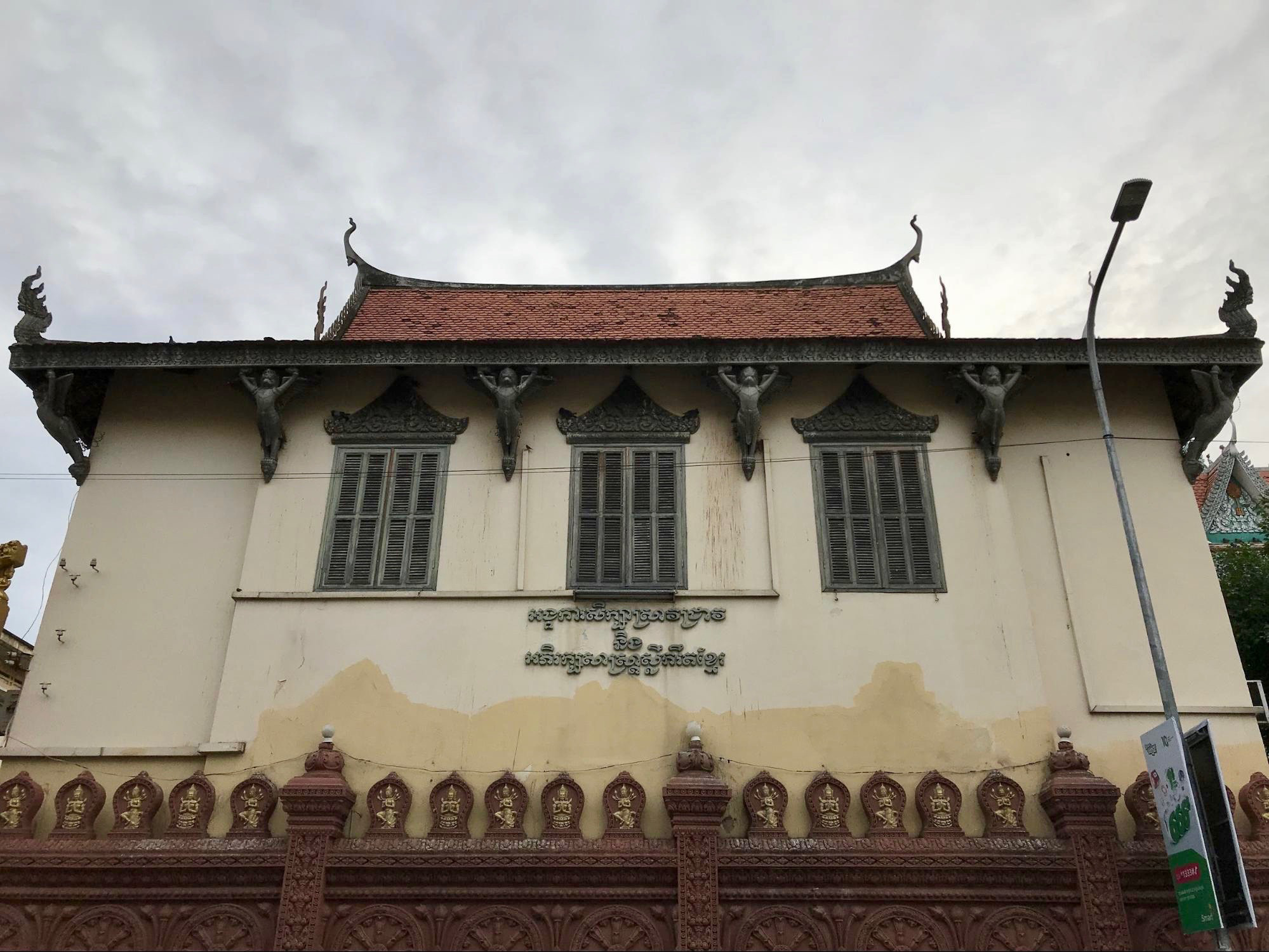
The FEMC building in the Wat Ounalom temple compound.

Deteriorating palm-leaf folio that was encapsulated by the FEMC to prevent further damage.
We are especially indebted to: Kun Sopheap, Leng Kok-An, Olivier de Bernon, Mech Khoeun, Chhom Kunthea, Suon Kosal, Suong Sereykhosal, Vann Narith, Trent Walker, David Wharton, Jacqueline Vincent, Alexis Lecoq, Chansothida Lun, Vichet Son, Sophannarith Tith, Sokea Sang, Channy Chorn, Leakana Orm, Nimol Chhorn, Theany Chim, Sopheaneath Penh, Chhaiya Yon, Sin Sam, Chantrea Vort, Rachhan Voeun, Channthai Teng, Samath Ouch, Sopheaktra Kheang, Thavath Phan, Davin Som, Porleas Kung, Saray Saron, Seivmey Chum, Phearom Chhoeun, Soben Men, Dalin Tha, Sam Ath Chou, Samai Pon, Sreypov Sort, Then Lorn, Chamreun Ban, Thida Heang, Phanith Hun, Linna Chean, Sophy Chhuon, Thaknita Mao, Neardey Pho, Pheak Hav, Sophorn Lang, Veasna Touch, Saovithong Sam, and the many generations of local custodians who have copied and protected the manuscripts to this day. Without their dedicated work, this project would not have been possible.
The École française d’Extrême-Orient was founded in 1898 in Saigon, Vietnam, originally as the Mission archéologique d’Indo-Chine. In Cambodia, it first established the Conservation of the Angkor archeological site in 1907, then the School of Pali, the National Museum in Phnom Penh, the Royal Library, the Buddhist Institute and the Vat Poveal Museum in Battambang over the following decades. EFEO scholars began working on Cambodian manuscripts in the early years of the 20th century, primarily on canonical and commentarial texts of the Pali canon which were then accessible in Phnom Penh. Ms. Suzanne Karpelès, the first female member of the EFEO, was the inaugural Curator of the Royal Library of Cambodia (now the National Library), established in 1925, and was instrumental in the founding of the Buddhist Institute in 1930, where she was Secretary General. In 1943, under the direction of Mr. Pierre Dupont, also a member of the EFEO, the Royal Library was made part of the Buddhist Institute, which remained active in Khmer studies until the Khmer Rouge regime in 1975. Mr. Thaong Yok (1921-2007), a master of Pāli studies and the last living colleague of Ms. Karpelès, would later become a key member of the EFEO-FEMC team, personifying the EFEO’s contribution to the study and conservation of Cambodian manuscripts over more than a century.
Following the collapse of the Khmer Rouge regime in 1979, a number of outstanding individuals undertook the rescue and protection of the old collections of manuscripts in Phnom Penh. Among those of the former Buddhist Institute, the largest part was safeguarded by Venerable Preah Vanarat Ken Vong, one of the first six monks to be re-ordained in Cambodia.
The Fonds pour l'Édition des Manuscrits du Cambodge was established under the auspices of the École française d’Extrême Orient (EFEO-FEMC) in 1990 with the aim to systematically inventory and photograph Cambodia’s surviving manuscripts. Professor Léon Vandermeersch was the Director of the EFEO at that time, and Professor François Bizot was in charge of its manuscript publication fund. Following several preparatory missions, Prof. Bizot obtained permission from the Khmer authorities for the project to be based in a small pavilion within the compound of the former Royal Palace Museum. Under the direction of Professor Olivier de Bernon, a team of Cambodian staff began to restore, identify, and inventory the manuscripts they located in Phnom Penh and later in other provinces. King Norodom Sihanouk had already been actively encouraging this mission in Cambodia since 1989 and when he returned to Cambodia in 1991 he graciously invited the project to continue at the Royal Palace, and in 1993 it was placed under senior royal patronage. In 1999 the project moved to the compound of Wat Ounalom (Vatt Uṇṇālom) at the invitation of His Holiness Supreme Patriarch Samdech Tep Vong.
The work done by the EFEO-FEMC was funded since its inception by the French Ministry of Higher Education and Research and the Ministry of Foreign Affairs. Its work was undertaken in concert with the Cambodian Ministry of Cults and Religion and the support of the Ministry of Culture and Fine Arts, which seconded a number of its staff members. Since 2012, the work of FEMC has continued independently of the EFEO, with the ongoing approval and financial support of the Cambodian government, and continued guidance from Prof. de Bernon. Key Cambodian members of the EFEO-FEMC team have included Mr. Kun Sopheap, Mr. Leng Kok-An, Mr. Thaong Yok, Mr. Ly Sovy, Mr. Yun Polbo, Mr. Ros Soksambo, Mr. Vann Narith, Mr. Suon Kosal, and Mr. Tom Sarœun.
Since its inception, the EFEO-FEMC has visited over a thousand monasteries, mostly in Phnom Penh and the provinces of Kandal, Kompong Cham, and Siem Reap. Of these, just over one hundred still had a manuscript collection. Long-abandoned palm-leaf folios were often found wrapped in orange cloth, sometimes hidden in places such as false ceilings which were unknown to the current occupants of the temples, having survived due to the faith and courage of the people who took the risk to protect them during the Democratic Kampuchea regime. In Siem Reap province, only a single large manuscript library remained, at Wat Thipadey (Vatt Dhipatī), although surveys conducted in 2020 as part of the Khmer Manuscript Heritage Project revealed a number of less-complete manuscript libraries still extant in Siem Reap. In Phnom Penh and Kandal province, over 80 percent of monasteries surveyed no longer had a collection, and over two-thirds of the surviving manuscripts were incomplete. Nevertheless, the project team was able to restore, inventory, and film almost 2,000 manuscripts in the monasteries of the capital city and Kandal province during the period 1991–1996.
The project also worked on the major collections which were formerly part of the Buddhist Institute Library and are now held by other institutions in Phnom Penh. The largest among these comprises manuscripts which were rescued and collated by Venerable Preah Vanarat Ken Vong. In 1992, just two years before his death, he entrusted the restoration and inventory of these manuscripts to the EFEO-FEMC team. The resulting collection of more than 125,000 pages is by far the largest in the country and has become the EFEO-Preah Vanarat Ken Vong Library, which is now housed at Wat Ounalom. It was previously held at Wat Saravan Techo (Vatt Sārāvăn Tejo) where Ven. Ken Vong was the abbot.
In 1996, the EFEO-FEMC team discovered the only important manuscript library in Cambodia which was spared the destruction of the war and the Khmer Rouge—Wat Phum Thmei Serey Mongkol (Vatt Bhūmi Thmī Sirīmaṅgal) in Kampong Cham province (the story of the Wat Phum Thmei library was featured in a 2021 Tricycle Magazine article). When the 50,000 scattered folios were fully restored in 1998, two-thirds of the resulting 1,210 manuscripts were found to be complete, making this collection a key tool for the identification of other texts. In fact, Kampong Cham province is by far the richest for surviving manuscripts in Cambodia.
Smaller parts of the former Buddhist Institute collection housed in the National Museum and the National Library were also restored and inventoried by the project in 2002 and 2003 respectively. The National Library, with some 524 manuscripts, holds the second largest collection after the EFEO-Preah Vanarat Ken Vong Library. The only other manuscripts known to remain from the former Buddhist Institute collection, housed in one of the Silver Pagoda buildings within the Royal Palace compound, were also restored and inventoried by the EFEO-FEMC team in 2004.
During preservation work, each palm-leaf folio was dusted and cleaned, and oil applied when necessary, before being collated to recompose the fascicles, manuscripts, and manuscript bundles. It was sometimes also necessary to re-ink the folios in order to obtain clear images. After photographing, the manuscript fascicles were tied using combined silk and cotton cords, and the manuscripts bound between wooden covers encased in woven bamboo and fabric protective wrappings. These traditional cords and wrappings were made by elderly women and men in workshops established by the project. The EFEO-FEMC project also donated glass cabinets for manuscript storage.
In parallel to this extensive conservation and preservation work, the EFEO-FEMC project published the first and second volumes of the Provisional Inventory of Cambodian Manuscripts, and the filming of manuscripts between 1991-2004 produced some 400 strips of black-and-white film, documenting 757,507 pages of manuscripts. All photography was done in situ, using a Nikon F3 camera with a special back enabling 250 shots on Kodak Technical Pan and Kodalite black and white film. Copies of the negative and positive films kept at Wat Ounalom in Phnom Penh were originally digitized in 2009, under a joint EFEO-UNESCO program funded by the Embassy of Singapore. These black and white films, together with a collection of scanned leporello manuscripts and inventory data sheets, were newly digitized by Digital Divide Data as part of the collaborative project between BDRC and EFEO-FEMC in 2019-2021, and are now freely available via BUDA.